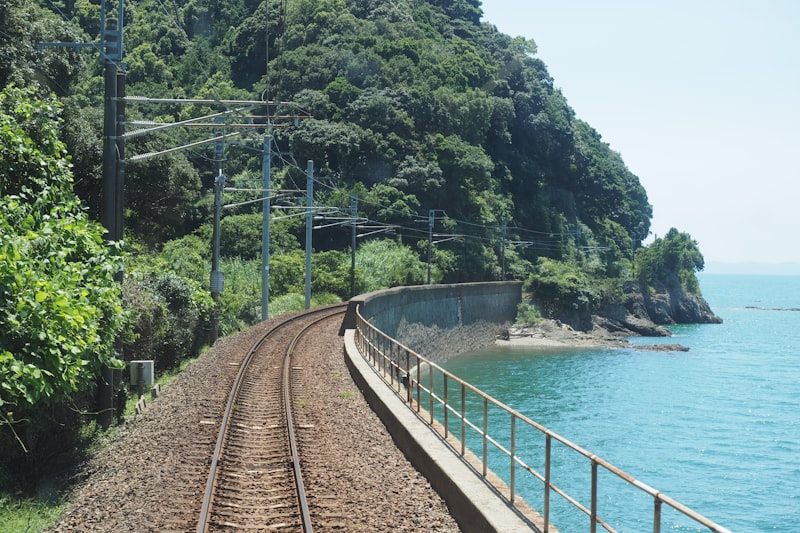
The emerald-green Yufuin no Mori limited express is one of Japan's most beloved scenic trains. Here's why this 90-minute ride through forested mountains is worth booking months in advance.
About the Train
The Yufuin no Mori (Forest of Yufuin) is a limited express service operated by JR Kyushu between Hakata station in Fukuoka and Yufuin, continuing to Beppu. Introduced in 1989, it was designed by acclaimed industrial designer Eiji Mitooka and has since become an icon of Japanese rail travel — frequently appearing in tourism campaigns and consistently ranked among the country's most beautiful trains.
The train's distinctive emerald green body with a wood-panelled interior draws its aesthetic from the forested highland basin it serves. Step on board and you're surrounded by warm timber fittings, high-backed seats with headrest covers, and large panoramic windows designed to frame the landscape rather than simply let it pass. The saloon car at the front — all curved glass and armchairs — is worth visiting even if you're seated elsewhere.
The Route
The Hakata–Yufuin segment takes approximately 2 hours 10 minutes. The first half runs through Fukuoka's suburban sprawl and the rolling hills of central Fukuoka Prefecture, pleasant but unremarkable. The journey transforms as the train climbs into Oita Prefecture through the Hita valley — the line passes alongside the Chikugo River, curves through tunnel after tunnel, and emerges into a landscape of forested gorges and rice terraces that feels entirely separate from urban Japan.
The approach to Yufuin is the most dramatic section. The train descends through mountain passes with sweeping views of the Yufuin basin below — on clear mornings, the valley is filled with a sea of mist from which the twin peaks of Yufu-dake rise like islands. The arrival into Yufuin station, a beautifully crafted wooden building designed by Mitooka, feels like a proper arrival moment.
What to Expect On Board
The Yufuin no Mori has a small café counter serving Kyushu-themed snacks, bento boxes, and the train's signature soft-serve ice cream — a seasonal flavour inspired by the region. The bento boxes sell out quickly; the station kiosks at Hakata often have Yufuin-specific options worth picking up before boarding.
The train staff typically perform a brief narration in Japanese pointing out scenic highlights. An English leaflet with key points is available on request. Photography is actively encouraged, and the saloon car fills up quickly at departure — if you want a good shot from the front windows, head there in the first 20 minutes before seats fill.
Booking and Tickets
The Yufuin no Mori runs three or four times daily in each direction. Seats are reserved-only — walk-on is not possible. Book through the JR Kyushu app, at any JR ticket window, or via the JR Pass exchange counters on arrival in Japan. The service is covered by the JR Kyushu Rail Pass and the national JR Pass, with only the limited express supplement required for pass holders.
- Book as early as possible: Seats sell out weeks ahead during Golden Week, autumn foliage season, and weekends year-round.
- Best seats: Odd-numbered seats on the left side of the train face the most dramatic mountain views on the Hakata–Yufuin direction.
- Return journey: The Yufuin no Mori continues to Beppu — consider a one-way ticket to Yufuin and continuing by bus or the local train to Beppu for onward Kyushu exploration.
Book Tours & Experiences
Kyushu onsen day passes, food tours, scenic train tickets and more.
Browse on KlookAffiliate link — we may earn a small commission at no extra cost to you.
Final Thoughts
Kyushu is the Japan that many travellers dream of but rarely find: authentic, unhurried, breathtakingly beautiful, and utterly original. It's a place where ancient traditions live comfortably alongside modern Japan, where you can soak in a private forest rotenburo at dawn and eat exceptional ramen from a street stall at midnight.
We hope this guide helps you plan an unforgettable visit. Feel free to explore our destination guides, ready-made itineraries, and ryokan recommendations for more detailed planning resources.